How to Evaluate Vault Risk
Nexus Mutual Team
·

Vaults are becoming a popular instrument for yield, but a vault doesn’t actually produce yield itself. Underneath every vault token there might be a lending market, a cash-and-carry basis trade, a pool of tokenized credit, a mix of all three, or an entirely different strategy. The token makes that exposure easy to enter and leave, but it doesn’t change what earns the yield and the associated risks.
Nexus Mutual has covered vault risk since the first vaults launched in the summer of 2020. Some of the earliest payouts followed the Yearn Finance hack in 2021, for more than $2 million, a huge amount for DeFi at the time. Since then, vaults have only grown in complexity, evolving from single-strategy smart contracts into the multi-layer, multi-asset protocols they are today.
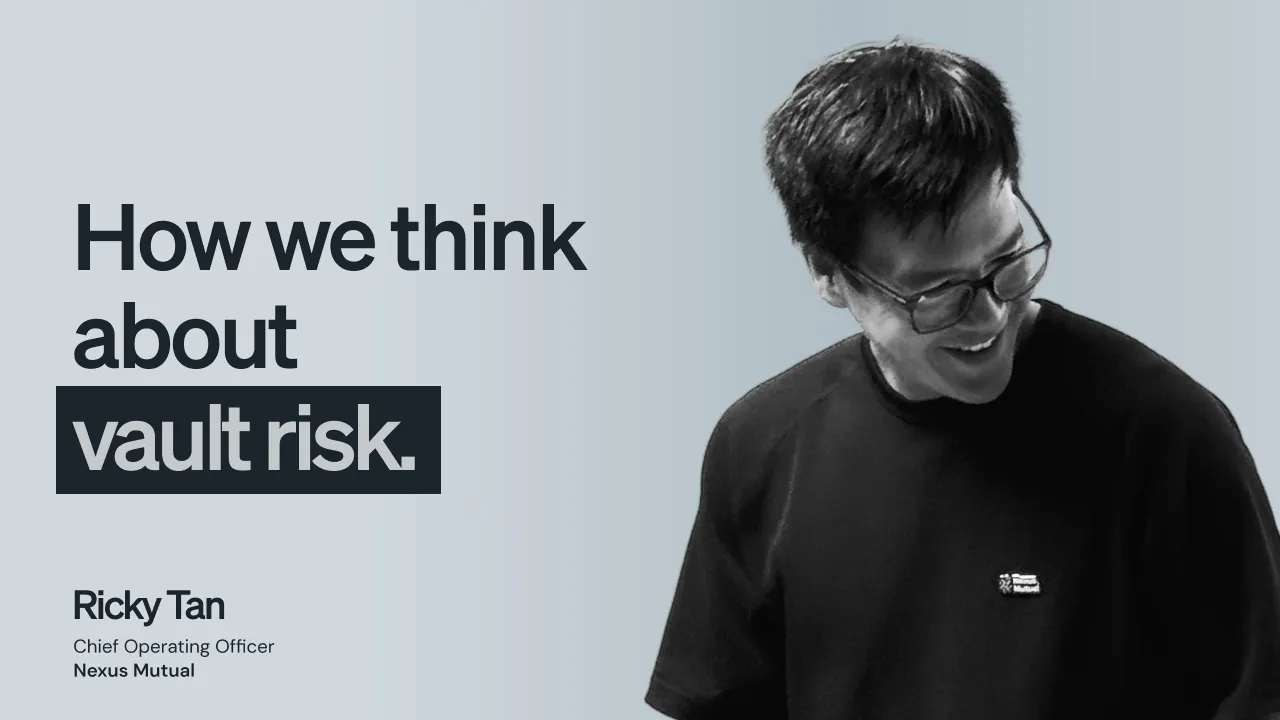
Ricky Tan, our Chief Operating Officer, explained how we assess that risk in the first episode of Vault Design, a four-part series from Where Yield Comes From.
1. Smart Contract Code and Permissions
At the foundation of every vault there’s a core layer of smart contract code. The vault contract itself, its integrations with other DeFi protocols, and the permissions that determine who can change the code and those integrations. Most of this layer is deployed by a vault protocol such as Morpho, Euler, or Upshift.
That core risk is compounded by every other protocol and DeFi venue the vault integrates with. An exploit here can be the most critical, because funds can be stolen outright and the damage can be widespread or even catastrophic.
2. Assets, Strategies, and Curators
Above the code and permissions sits the asset and strategy layer. What collateral can be deposited into the vault? What assets and strategies does the vault deploy into? What can be borrowed against those assets, and at what loan-to-value levels?
This is also where the vault curator or manager comes into play, such as Steakhouse Financial and Gauntlet.
In the past, vault positions were mostly crypto-native tokens that were fully transparent because of their onchain nature. Recently, an increasing share of vaults represent offchain real-world assets. At that point the vault loses much of the transparency DeFi protocols provide, and counterparty risk becomes much harder to assess.
3. Pricing and Liquidity
Every vault position has to be valued, so it needs a price feed. These oracles come in different configurations and every design carries tradeoffs, but they all share one goal - if the value of the vault’s collateral falls, positions need to be liquidated in an orderly way.
A badly configured oracle, or a fixed-price oracle where the price should float, can cause liquidation failures and socialize significant amounts of bad debt across vaults. Each vault also needs a liquidity buffer to manage sudden increases in withdrawals and liquidations, and if that buffer is too small the risk of a bank run goes up.
How One Loss Cascades Through All Three
These layers carry different but connected risks, which means a problem in one can cascade into the others.
When a real-world asset in a vault suffers an impairment, that isn’t necessarily an issue. If the loss isn’t accounted for correctly, the consequences can pile up. Take an example of a vault that has lent $80 against a real-world asset token representing $100 of offchain credit.
Stage | Collateral is really worth | Oracle reports | What happens in the vault |
|---|---|---|---|
The loan is made | $100 | $100 | An $80 loan sits against $100 of collateral |
The credit suffers a loss | $60 | $100 | The loan still appears healthy, so liquidation is delayed |
The oracle is finally updated | $60 | $60 | The collateral is liquidated for $60, which leaves $20 unpaid |
That $20 is bad debt for the vault. At a larger scale, any early withdrawals at the overstated value leave less behind and concentrate the losses among the remaining vault token holders.
“This is just one example of how an asset problem becomes an oracle problem and a liquidity problem," said Ricky Tan, COO at Nexus Mutual
How Nexus Mutual Assesses a Vault
Nexus Mutual treats a vault as the sum of its parts and tries to verify everything onchain and offchain. Every one of our vault risk assessments has to include the following.
The underlying vault protocol’s smart contracts
The full history of the smart contract audits
An overview of every single underlying asset position
Information about the curator
All relevant information about the oracle and the liquidity buffer
Where the onchain evidence trail ends we look for offchain evidence, which includes who the custodian is, who sets net asset value, what the redemption terms are, and who we can speak with directly if things go wrong.
Anything that can’t be verified independently increases the risk, and therefore the premium for cover. Furthermore, vaults aren’t static. That’s why ongoing monitoring is in place to scan for drift, which can materially affect the risk assessment.
Who Gets Stuck with the Loss
Because losses can occur in any of the layers, there’s no single answer as to who bears all of the risk.
First-loss capital. Where a vault platform or curator holds some form of first-loss capital or self-insurance, that layer is most likely to absorb losses first.
Cover. Cover from companies such as Nexus Mutual can provide the next layer of protection, when available.
Depositors. Any remaining uncovered losses are crystallized, either directly or over time, and borne by the vault depositors themselves.
Cover can also be built into the vault itself, as it is in the Edge Capital and Kelp vault and OpenCover’s Covered Vaults.
You’re Covered with Nexus Mutual
As the number of vaults and the types of assets deployed into them continue to grow, thorough due diligence and risk assessment will only become more important. Whether you’re a vault depositor, curator, or protocol developer, understanding the different layers of risk and how losses can cascade across them is crucial.
Watch the full episode and follow the rest of the Vault Design series, which moves on to curation, policy, and setup. Where Yield Comes From also offers a free Vault Risk Assessment download with a field guide, an Agent Skill, and an assessment worksheet.
If you have other questions about vault risk, you can always reach out to us at Nexus Mutual to get our opinion.
More from the blog


Have questions about securing your crypto?

Subscribe to our newsletter
Be the first to know about our latest news, announcements and events!

This website is operated by Collective Risk Services CIC, with its registered office at 71-75 Shelton Street, Covent Garden, London, United Kingdom, WC2H 9JQ, on behalf of Terrapin International Foundation
© 2026 Nexus Mutual
