Nexus Mutual Team Talks: Rox (CTO, Nexus Mutual) on building a security-first engineering culture
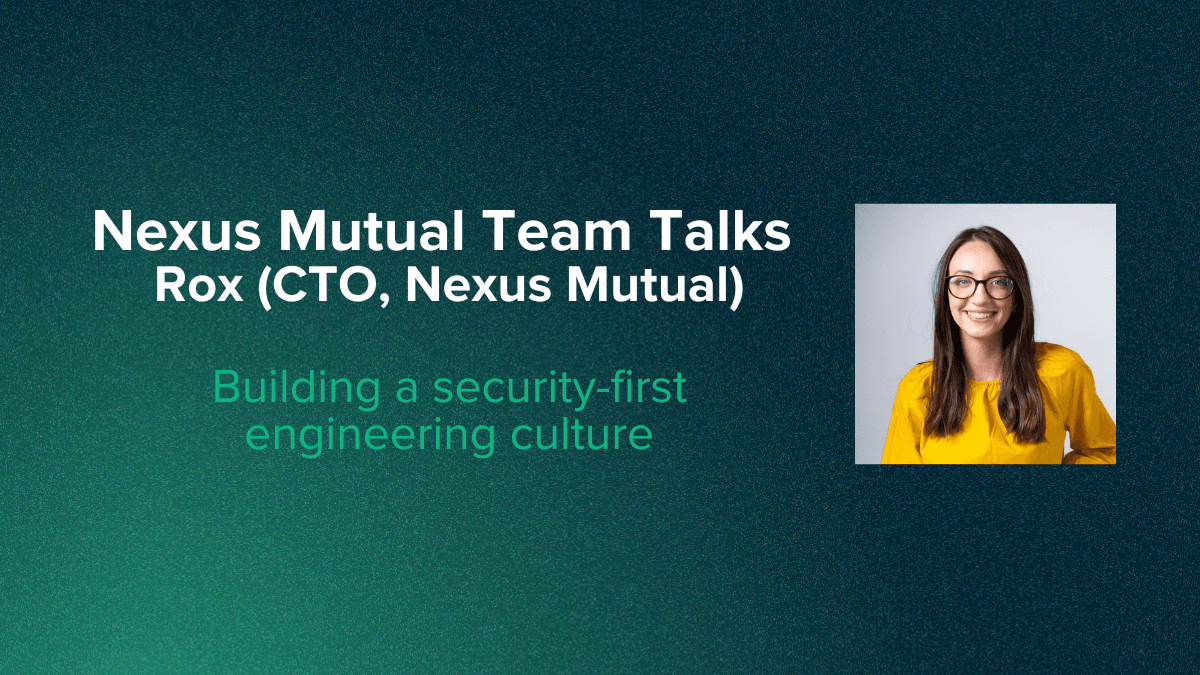
When it comes to building on the blockchain, there are no second chances: that’s why Nexus Mutual has to make sure its code is bulletproof.
In this edition of Nexus Mutual Team Talks, our interview series spotlighting the people behind the first crypto insurance alternative, we sit down with Roxana Danila, Nexus Mutual's CTO. She joined in 2019, shortly after Nexus Mutual went live on mainnet, and has since built the engineering team and culture from the ground up.
What were you working on before Nexus Mutual?
Rox: I've always been drawn to technology and mathematics. After graduating from Imperial College London, I joined Meta (then Facebook) as a Software Engineer. Over the next five years, I worked across a wide range of teams: from building user-facing product features, to large-scale spam and fake account detection, to deep infrastructure work improving performance and CPU efficiency.
After five years, I left Facebook to explore entrepreneurial paths. I've been interested in crypto and Ethereum since 2015 and co-authored one of Facebook's first blockchain patents. When I met Hugh and the team, the mission immediately resonated. Joining Nexus Mutual felt like a natural next step and a chance to work on something that genuinely mattered.
How would you describe Nexus Mutual’s technical mission to someone new to DeFi?
Rox: We're building the technical foundation for the first crypto insurance alternative. That means designing systems that are secure by default, transparent in how decisions get made, and resilient under stress.
Put simply: we're building the risk management infrastructure that helps people and organizations use crypto with more confidence.
From zero engineers to a full team: how has your role as CTO evolved?
Rox: When I joined in 2019, there was no engineering team. I built everything from scratch. Beyond owning the technical roadmap, I wore many hats across the wider organization, helping with customer support, HR, product, or wherever I was needed.
The first engineer I hired is still with us, now owning the architecture of the systems and solving the big, hard technical problems we face. When it was just the two of us, I was very hands-on: deep in the codebase, spending 12-hour days building, testing, and establishing our core architecture and standards.
Going from one to six engineers shifted my role from execution to orchestration. I’m in charge of enabling others to do their best work: setting the direction, making sure we have the right foundations, and keeping quality and security high as we scale. I learned on the job and grew into a different kind of CTO.
Ultimately, my biggest focus is shipping safely, consistently, and with clear strategy. I spend more time on long-term architecture, risk management, and prioritization across initiatives, as well as hiring and mentoring. I'm still close to the technical details, especially when we need to clarify business intent with the BD team, and step in cross-functionally, mainly helping with product ownership and creating alignment across the team.
What kind of engineering mindset do you look for at Nexus Mutual?
Rox: A high-ownership mindset is a must. We expect everyone to take initiative and attend to details when they identify a problem. Security is non-negotiable.
We also need proactive learners. DeFi moves fast, and there are always new technologies and design patterns to absorb. This matters even more given we're industry-first in our line of business. We need people who ask the right questions and go down the rabbit hole to find answers.
Above all, I look for a genuine passion for building: people who care about craftsmanship, challenge assumptions, and take pride in shipping work that's robust and impactful.
What’s one technical principle you’re unusually strict about?
Rox: Security is a first-class product requirement - we design with that in mind from the start. At every step, we try to poke holes in the system. If something isn't secure, it doesn't ship, no matter how small the change or how tight the timeline. Given the stakes, we optimize for correctness and safety over speed.
This mindset might seem counterintuitive alongside the startup instinct to "move fast and break things." Always optimizing for security can look like a disadvantage to some, but it's worked well for us.
One more principle which may sound old school: I care about clean code. Messy code is a sign of a messy mind, and that means mistakes.
How do you decide what you should personally do vs delegate?
Rox: The main decision parameter is ambiguity. If the "what" and "why" aren't clear because of uncertain requirements, competing constraints, or heavy cross-functional context, I get involved early to clarify outcomes and translate business intent into an engineering plan. Once the problem is well-defined and ownership is clear, I step back and focus on enabling quality: removing blockers, supporting decisions, brainstorming, and keeping the team aligned.
The other time I lean in is for late-stage delivery on high-impact projects. As we approach a major deadline, I increase my involvement to de-risk execution: tighten scope, sanity-check assumptions, surface edge cases, and make sure we're not trading quality or security for speed. The goal is to keep the team moving fast while protecting reliability and trust.
All of our engineers are talented and responsible. That makes my job a lot easier. It's important to work with people you can trust.
What are some trade-offs that come up during planning?
Rox: A lot of planning comes down to balancing speed with timing. Shipping quickly matters. Delivery affects revenue, partnerships, and momentum, and the wider crypto market cycle can shift faster than your roadmap. But we're operating in a security-critical environment, so moving too fast can introduce risk or technical debt that's far more expensive later.
A few other trade-offs we often face:
New features versus strengthening foundations: investing in security, reliability, monitoring, and internal tooling doesn't always look like it’s driving growth but strengthening our foundations makes everything safer and faster over time.
Flexibility vs simplicity: it's tempting to design for every future scenario, but simpler systems are easier to understand, review, and maintain, especially when smart contracts are involved.
Short-term delivery versus long-term maintainability: choosing an approach that ships quickly versus one that sets us up to iterate safely for the next year.
The way we handle these is by making trade-offs explicit: what outcome matters most right now, what's the acceptable risk level, and what's the smallest secure increment we can ship to capture the opportunity without compromising trust.
What’s a technical decision you'd make differently today?
Rox: I would have shipped Nexus v2 in incremental pieces rather than bundling so much into a single push. Larger re-architectures carry a lot of execution risk.
In hindsight, I also wouldn't start a major re-architecture right before going on maternity leave. That taught me that architecture decisions aren't just technical, they're also operational. Timing, continuity, and executional risk management matter as much as the design itself.
What excites you the most about Nexus Mutual in 2026?
Rox: We have several new cover products and integrations coming live soon. Most are genuine firsts in the industry, and I'm excited to see them in the hands of our members.
Our protocol and architecture have matured significantly over the years and provide a solid foundation. Behind the scenes, we're investing heavily in automation and modernization across our backend stack. The goal is straightforward: better developer experience and faster feedback loops, so we can reliably ship improvements at a higher cadence.
I'm also excited about raising the bar on user experience around cover and claims. If we want more institutional users and wider adoption beyond the early DeFi community, DeFi products need to be clearer, smoother, and inspire confidence end to end.
More broadly, it's been encouraging to see how much the market has matured since 2019. DeFi has expanded beyond the original circles, and our work is starting to get attention outside the OG community. Vaults as a major architectural trend in DeFi open up many new embedded cover opportunities for us. The space has gained legitimacy, and that creates the conditions to build longer-term, more resilient products.
